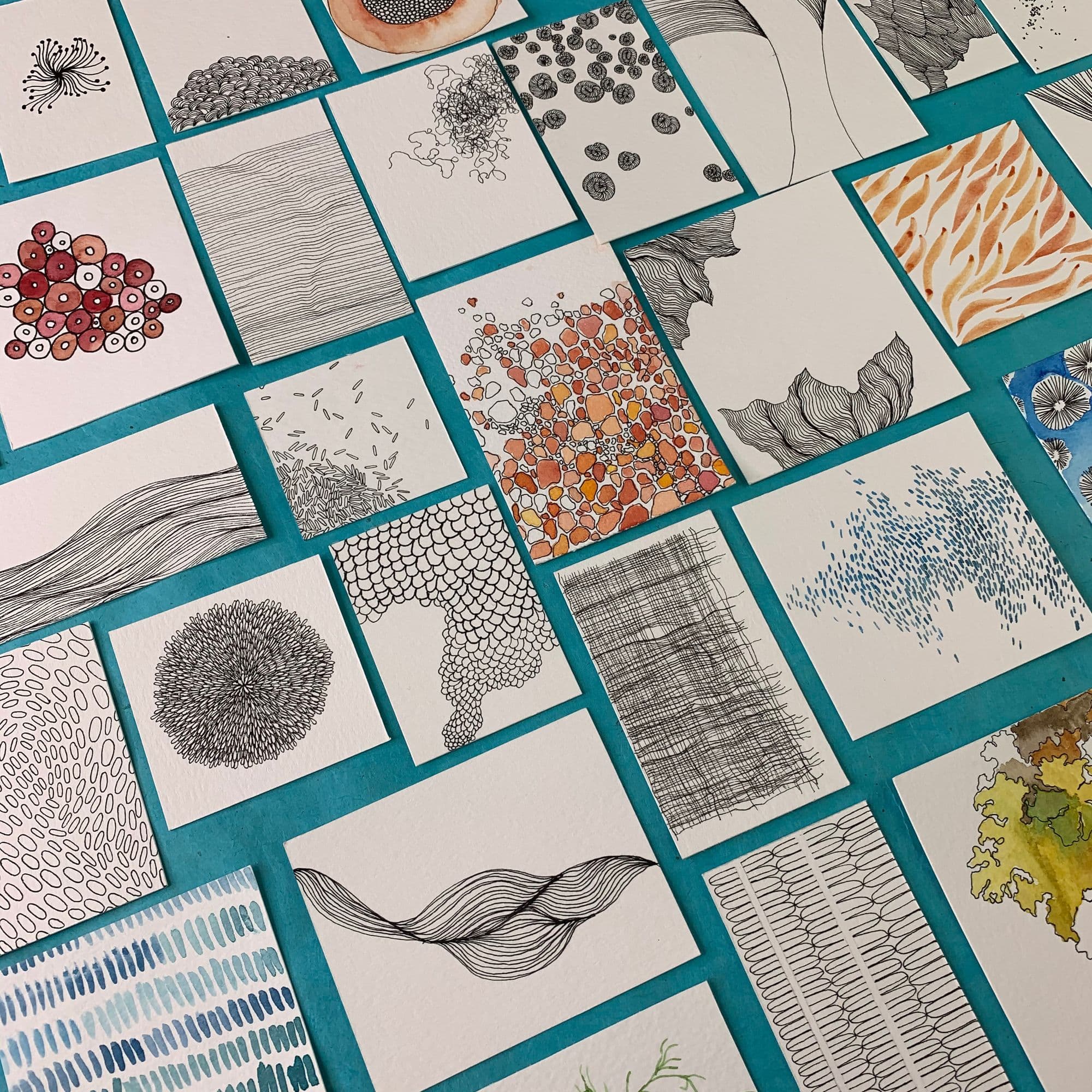
From boosting focus to supporting emotional wellbeing, your absent-minded doodles might be doing you more good than you realise
When it comes to meetings, I can’t help myself; I just have to doodle. Smiley faces in every O, little flowers trailing the corners of my notes, random squiggles to highlight words or tasks. If I’m not doing something with my hands, my brain starts to wander, and focusing on the meeting at hand? It’s impossible.
We tend to think of doodling as a distraction – something we do absent-mindedly during phone calls, meetings, and in moments of boredom. We’re told off at school for leaving little patterns in the margins, and we worry people might think we’re not listening if we’re making our marks on scrap paper or napkins. But what if those small, seemingly insignificant sketches are actually doing us a lot more good than we might think?
What are the benefits of doodling?
Doodling is far from a waste of our time. It can help us to focus, process how we’re feeling, spark creativity, and even help boost our memories. We spoke with Counselling Directory member and Counsellor, Jessica Grasham, MA Hons, PgDip-PCC, MBACP, NCPS accred, APCCA accred, to find out more about the benefits of doodling.
“Putting pen to paper in a classic doodle distracts, passes time in fun mindful moments, and helps regulate and reset,” Jessica shared. “The right-hand side of your brain is the creative side, allowing feelings, intuition, imagination, and ideas to flow.”
Doodling offers a way to free yourself and to express yourself creatively without judgement. Even if you don’t see yourself as creative, doodling can still be beneficial.
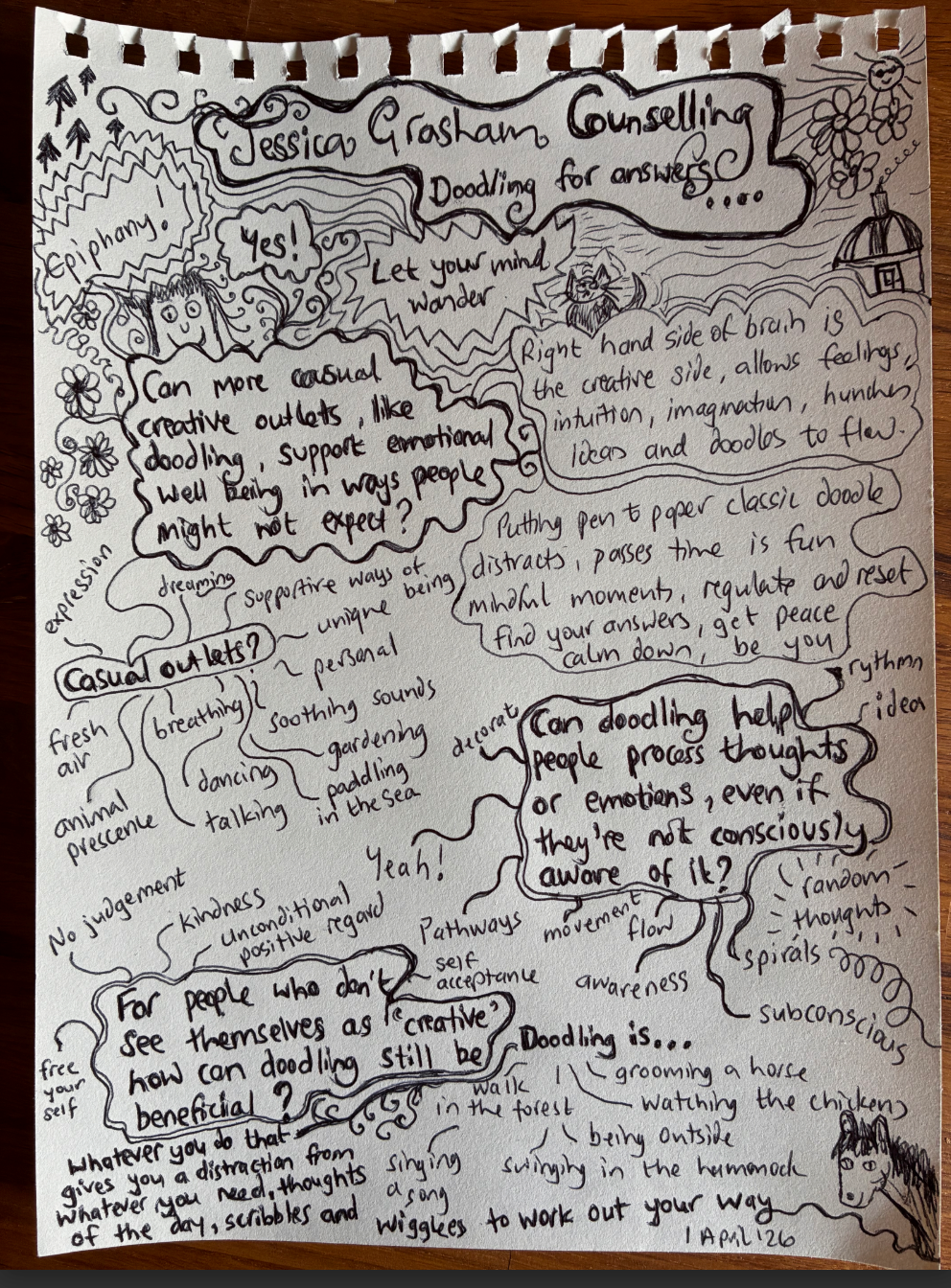
While doodling might feel like a simple way to pass the time, it can have even more benefits than we might realise. It may even play a more active role in how we think, focus, and process information…
Doodling for focus
One of the most well-known studies on doodling comes from psychologist Jackie Andrade (2009). The study found that when asked to listen to a dull, rambling voice mail, participants who doodled were able to recall more information than those who simply listened. It’s thought that, when bored, doodling can help you to find your focus. This may also help explain why some people find they listen better when doodling.
By giving yourself the permission to doodle, you can keep your brain lightly engaged – not enough to provide a distraction, but enough to stop you from switching off and daydreaming. Doodling can act as a kind of mental reset – a brief pause that helps us return to tasks feeling more refreshed.
Doodling as a gateway to creativity (and lower stress)
Many of us love – and embrace – our creativity, but it’s not always so easy for everyone. Some people feel pressure to be ‘good enough’ to be creative, which can stop them from getting started at all. Doodling creates a low-pressure space where you can explore your creativity and let your mind – and pen – wander. This kind of free-flow thinking can also support ‘big picture’ thinking, helping us step back and see connections we might otherwise miss.
With doodling, there are no rules, no expectations, and nobody has to see the results. You can doodle freely with words, images, patterns – or a mixture of all three – to see what unexpected ideas and connections might come up. When we allow ourselves to doodle, we can let go of the expectations for something we create to be ‘good’, as there isn’t a big, finished end goal we are aiming for.
One study found that after making any art (including doodles), 75% of participants had lower levels of the stress hormone cortisol in their saliva, suggesting that creative outlets can do more than help us focus in the moment, but can help us feel more relaxed, too.
Doodling and emotional processing
When words feel difficult, sometimes, art can provide a safe, accessible outlet. In art therapy, spontaneous mark-making – including doodling – is often used as a tool for emotional expression.
Doodling offers an easily accessible way of exploring art and creativity, as it doesn’t require specific skills or training. Repetitive patterns or shapes, colouring, or mindful drawing can all be helpful in creating a sense of calm and grounding.
“The arts can build our capacity for mindfulness, bringing ourselves back into the present and learning to let go of the past,” Integrative Arts Psychotherapist and Counselling Directory member, Miranda Jones, HCPC, MA, UKCP, BA, explains. “We can access flow states of concentration, which can be deeply beneficial. Some practices, for example, doodling, journaling or music, can become reliable lifelong resources supporting us in our daily lives, helping us to manage stress and strong emotions.”
Doodling becomes more than a habit. It can be a quiet, reliable way to process emotions and find moments of calm.
Supporting memory and learning one doodle at a time
Beyond focus, doodling may help you remember – and learn – new things. Visual note-taking, also known as sketchnotes – where you combine words, simple sketches, and structures like maps or diagrams – can help enhance information by combining verbal and visual processing.
By including visual as well as written notes, some people find that it helps them to capture more information, organise it in helpful ways, and retain it better. Dual coding theory suggests that we remember information better when we take it in both verbally and visually. By using doodles as one way of taking in information and storing it, we can reinforce what we are hearing verbally and, theoretically, remember it better.
Mindfulness in motion
Doodling can often be an unconscious action – you might find yourself making squiggles in the margins of your notebook, or drawing patterns on printouts while studying or at work. But it can also be practised more intentionally. When you focus on the movement of your pen, the shapes you create, and the physical sensations of drawing, it can become a form of mindfulness. The physical act of moving a pen across paper can also offer a subtle sense of grounding, bringing us back into our bodies as well as our thoughts.
Practices such as mindful drawing and mindful colouring can encourage attention to repetition, patterns, and breathing. These approaches can help support relaxation and awareness of yourself – physically and mentally – in the moment. Unlike with traditional mindful meditation, doodling can act as a physical focus – something that can be especially helpful if you find remaining still to be a challenge.
Doodling and neurodivergence
For many neurodivergent people – including autistic people and those with ADHD – doodling isn’t a distraction, it's a way to support our focus, sensory and emotional regulation. Research suggests that stimming is a crucial, adaptive, and largely positive tool for emotional and sensory regulation. Studies centred around autistic voices emphasise that stimming – repetitive movements, sounds, or actions, such as humming, tapping, or even doodling – can help with managing stress, reducing anxiety, improving focus, and can act as a form of self-soothing.
Rather than pulling attention away, doodling can be one of many different ways to help provide a point of focus and an outlet, especially in environments that may require listening over a prolonged period of time. It can help us to focus and process information.
While doodling can have plenty of benefits, it doesn’t come without its caveats. For some, doodling can provide a distraction in the moment – especially if there are visual elements you should be taking note of. A 2017 study found that in meetings where participants needed to take in visuals like graphs and charts, unstructured doodling weakened their ability to recall information. If you are expected to actively take part in a meeting, you might find doodling can be distracting.
Remember: What works for one person, doesn’t always work for another. It’s about finding strategies that help you to stay on track.
Doodling for good: How to get started
If you’ve ever felt self-conscious about doodling or have had bad experiences with being told off for doodling in the past, it could be time to reframe your thoughts and to give doodling another try. There’s no right or wrong way to get started. Why not try and:
- Start with simple shapes or patterns.
- Let your hand move without overthinking – you don’t need to have a plan!
- Doodle while listening to music or a podcast, while thinking about a project, or reflecting on your day.
- Give yourself a moment to reflect after you have doodled. How are you feeling? Focused, calm, relaxed?
You don’t need to be an artist to doodle, and you don’t need a reason to begin. Sometimes, simply making a mark is enough. So the next time your pen starts to drift across the page, you might not need to stop it. Instead, you could follow where it leads and see what unfolds.



Find a professional today
Try our guided search tool, we can connect you with over 20,000 professionals.