Meet Happiful Poetry Prize 2026 runner-up Jane Fuller

updated on Jul 28, 2026
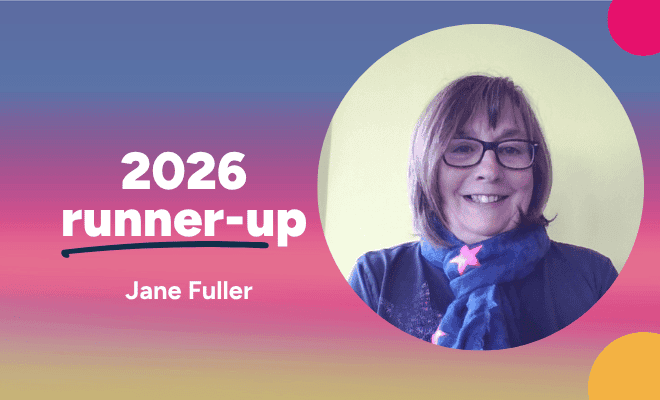
Runner-up Jane Fuller's poem, When a Heart Lies in Creases, uses the image of origami to explore the many emotional states we carry through life.
Here, she reflects on returning to writing at 50, balancing creativity with caring responsibilities, and why poetry became a much-needed outlet.
Feeling inspired? Learn more about the 2027 Poetry Prize which opens on 1 September, 2026.
How long have you been writing poetry?
I used to write poems when I was a girl. In fact, I recently found a book of poems I made for my grandparents as a Christmas present when I was 11!
A long hiatus followed, and I didn't write creatively again until I turned 50.
What does your writing life actually look like day to day?
I write whenever and wherever I can.
I care for my adult son, who is disabled, so sometimes life gets in the way and I can't write anything down for weeks.
The good thing is I've always been a daydreamer, and your imagination is always with you, so in a sense I'm always writing in my head.
I'm lucky because my son loves stories and poems. Even if I can't dedicate time to writing, I'm always sharing my words with him.
Do you consider yourself a poet first, or is poetry something you fit around other responsibilities?
Poetry is a much undervalued art form, but I'm proud to call myself a poet.
At the same time, it's something I fit around the other parts of my life, particularly my caring responsibilities. Writing is a part of who I am, even if I don't always have the time to sit down and do it.
Can you tell us about the process of writing your winning poem?
This poem emerged because I was thinking about emotions and mental health.
Life can be challenging, and there seems to be an explosion of melancholia at the minute.
I reflected on my own experiences, but also on the way we fold ourselves into different emotional states and personas every day.
That made me think about origami shapes, and I ran with that imagery.
I'm naturally an optimistic person, so I wanted the poem to end on a hopeful note.
Did you experience any imposter syndrome around your poetry? What helped you submit it to the competition?
I submitted to the competition because I loved the theme and because I enjoy sharing my work, even though doing so always brings the possibility of rejection.
No one likes being rejected, of course, but you can't take it personally.
What mistake do you see new poets making too often?
I'd say not giving themselves permission to write freely.
All writing is rewriting, so don't worry about getting everything right in the first draft.
Try to identify what's preoccupying you or what you're really trying to say, then build from there.
What role does poetry play in your wellbeing?
Poetry, and writing more generally, play a huge part in my wellbeing.
Looking back, I think I first took it up because I needed a kind of respite – a creative safety valve.
I'm no good at crafts and can't draw to save my life, so poetry was an art form that felt accessible.
It also costs very little. You can scribble on paper, send yourself voice notes or use a computer in the library.
Eventually your ideas either evaporate or they grow into a finished poem.
Has writing helped you understand yourself differently?
Definitely. I've grown to see myself as a writer, not only as an unpaid carer.
Writing means tapping into your thoughts and feelings and recording them, and that naturally brings a greater sense of self-awareness.
What are a few tips you would give to someone getting started with writing poetry?
- Set your mind free. Don't worry about making the first draft perfect.
- Remember that all writing is rewriting. The real work often happens during editing.
- Pay attention to what's preoccupying you. That's often where your strongest ideas are hiding.
- Make use of free resources. There are plenty of online guides to help you develop your craft.
- Keep going and enjoy the process. The more you write, the more your own voice will emerge.



Find a professional today
Try our guided search tool, we can connect you with over 20,000 professionals.