Community Corner: Meet the music group making choir practice open to all

updated on Apr 30, 2026
Through free, inclusive choir sessions, Accessible Inclusive Music is proving that there is no single way to make music – and that every voice has value…
Long before we find the words to speak, we respond to rhythm. A lullaby can calm us, a familiar melody can lift our mood, and singing together can help us feel like we belong. Music is with us from the very beginning, offering comfort, expression, and community. But, if musicality is part of what makes us human, surely access shouldn’t depend on ability? Yet for many children with additional needs, access can be hard to find.
In 2021, when her own son faced those barriers, Sarah Dunn decided to create something different. “Accessible Inclusive Music (AIM) was inspired by my son, who is disabled, and loves music,” says Sarah, who was faced with a lack of musical activities in the local area that met her son’s very specific needs.
“He wanted to participate meaningfully in music-making, and this was really tricky for him as a non-mobile, non-verbal, full-time wheelchair user, who can’t use his hands or arms in a functional manner,” Sarah says.
As the British Association for Early Childhood Education recommended in a 2018 report, music should be seen as a core component of children’s learning. However, many youngsters, like Sarah’s son, lacked proper access, which excluded them from this vital development avenue.
Knowing how important music is for young people, Sarah was determined to figure out a means for her son to take part in a way that worked for him. Inspired, she got together with other practitioners and volunteers in the area to solve the problem.
Since then, Sarah and the team have provided free weekly choir sessions to children and young people all across the UK, have offered workshops with Bradford and Airedale Youth Choir, and collaborated with Leeds-based charity SNAPS Yorkshire to provide in-person inclusive choir sessions as well.
The weekly online choir sessions have become a firm favourite with the community, where parents, carers, and children can take part – whether they consider themselves to have additional needs or not. The beauty of these sessions is that they allow everyone to get involved in a way that’s accessible to them, whether that’s signing, using Makaton (a language program that uses signs, symbols, and speech), body movements, making sounds, using assistive technology such as an eye-gaze or switch, or simply listening to other people.
“The changes we have seen in our participants have been incredible,” says Sarah. “We’ve witnessed increased confidence, leading to improved self-esteem and positive wellbeing, alongside development in their music skills.”
According to a systematic review published in the Journal of Intellectual Disabilities in 2022, there is a lot of research to support the idea that music-based interventions can offer real improvements for young people managing health challenges, offering a tool that complements other medical support.
The research found that participants reported increased awareness and attention, as well as affected mood, communication, and playfulness. Although further research is required to develop robust and effective music-based interventions that suit the needs of people with learning disabilities, for AIM, the proof is in the pudding.
As participants return week after week, many of them go from being too shy to be on camera to developing the confidence to sing a solo, or share a musical idea with the group.
“We have also seen members of the group who are preverbal say ‘hi’ or share how they are feeling by speaking,” says Sarah. “We even had one participant who wrote their own song for the online inclusive choir to learn!”
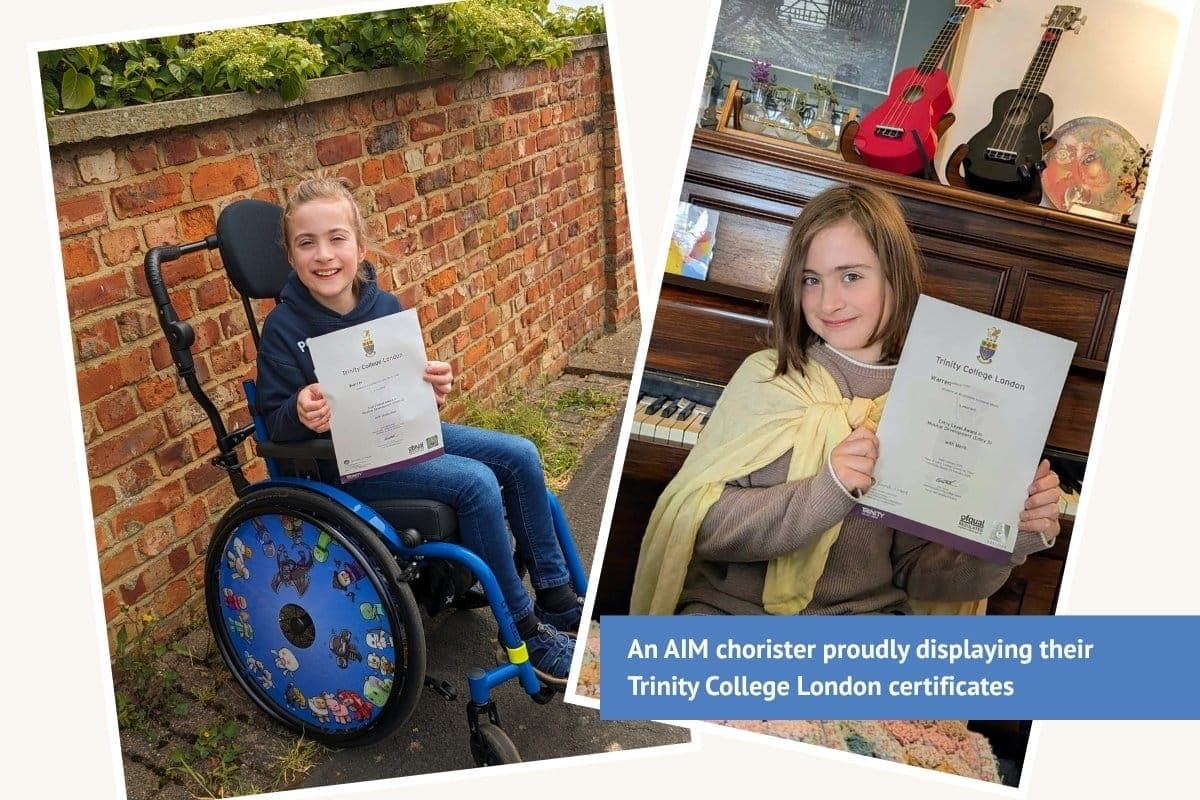
While the choir is a fun activity for most, many of the members have achieved musical development qualifications, awarded by Trinity College London in association with the Sounds of Intent framework, which officially certifies their ability to respond to, and create, sounds and music using their bodies, voice, and different musical instruments. Parents and carers have shared how positive it is for their children to be formally recognised for their musical ability.
One caregiver says that AIM has “opened up a new world” for one child, E*. “She is developing a real interest in music; this was something that seemed to have bypassed her previously.” Now, E can be heard singing around the house; “This is a pleasure to experience,” they say.
*Abbreviated for anonymity



Find a professional today
Try our guided search tool, we can connect you with over 20,000 professionals.