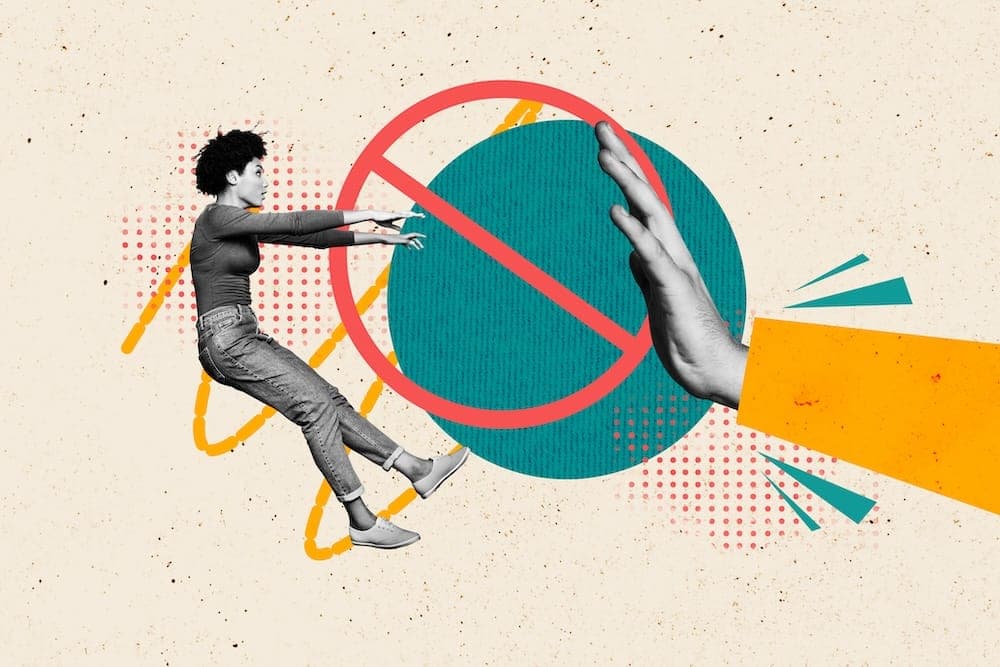
From the boardroom to the friend zone, rejection can sting. But, as we uncover, there are often opportunities for growth hidden in these experiences…
Rejection can come in many forms: feeling left out of a friendship group; missing out on a job offer; or even failing to win a competition. When these inevitable moments happen, we can find ourselves questioning our abilities, and ruminating over what this means about ourselves. As a result, it can give our confidence a knock that can be hard to shake.
“Rejection is a strong, and sometimes distressing, emotion, but we can turn it around to look at potential positives to move forward with,” says Dr Victoria Froome, a therapist supporting adults and young people through life’s challenges.
With a little reflection, we can see setbacks from a different angle, using them to learn more about ourselves, and clarify what truly matters. With that in mind, here are four techniques to try.
1. Use cognitive reframing
Often used in cognitive behavioural therapy (CBT), cognitive reframing focuses on deliberately changing the way you interpret a situation in order to alter its emotional impact.
For someone getting rejected for a job vacancy, Dr Froome explains that their automatic response might be something along the lines of: ‘My career progression ruined.’
“Working with that thought, we could generate some alternatives that can work as a motivator to move forward,” Dr Froome says. “Perhaps, ‘It might not have been the right role for me to step into yet,’ or, ‘If I develop my leadership skills further, I’ll be in a better position next time an opportunity comes up.’”
This reframe can help us cope with a difficult situation, while acting as a motivator to move forward in a positive way.
A. Write down your automatic response: “When [rejection] happened, I immediately thought ______ . ”
B. Challenge it: Write down three alternative perspectives, including at least one growth opportunity, that the situation might offer.
C. Reframe it: Choose a reframe that feels both honest and motivating. .
2. Shape the narrative
“This technique is subtly different to cognitive reframing, as we’re not analysing the thoughts and emotions; instead, we’re observing them, and using them as part of our story,” Dr Froome explains. “This can be valuable as it doesn’t minimise what’s happened, or our responses to it. It allows space to reflect, and consider what we want to take forward as part of our ongoing story.”
If you weren’t chosen for the lead role in your amateur drama club, for example, you might feel undervalued, embarrassed, or experience low self-worth. If you internalise those feelings, over time, you might start believing the ‘story’ in your mind that says you’re not good enough. Dr Froome explains that acknowledging those feelings, and looking for areas in your life that tell a different, more helpful story, can change your outlook.
For example, you might reflect on how your children love the lunches you cook for them, or how much your friend enjoyed the gift you gave them, reinforcing your sense of self-worth in a more holistic way.
3. Reframe your values
Sometimes used in acceptance and commitment therapy (ACT), values reframing gives us the space to consider what values we want to live by. For example, this might include things like respect, integrity, kindness, enthusiasm, and determination.
If you’ve not been invited to a friend’s party, it’s understandable to feel hurt. Try to consider how this relates to your values – perhaps around the importance of respect, connection, and friendship.
You could look at how these values show up in other relationships you have, and how you could nurture them. “This is a really important process, because it doesn’t minimise what has happened, yet, allows us to think around it, and this helps us to regenerate motivation and enthusiasm, while holding our important values close to us,” says Dr Froome.
A. Name the rejection: “What happened was ______ .”
B. Honour your feelings: “I felt ______ and that makes sense because ______ .”
C. Find the value: “This experience showed me that I care deeply about ______ .”
D. Look forward: “I can honour this value by ______ .”
4. Do a strengths audit
Finally, use this as a chance to shine a light on your current strengths, and make a plan for what you’d like to work on in the future. List your strengths – these might include empathy, creativity, reliability, problem-solving, humour, or resilience. Then, note what you’re developing, or could develop, as a result of the rejection experience.
The advantage is twofold: it rebuilds confidence in the short-term, and gives you a roadmap for growth in the long-term. As Dr Froome says: “This way, you’ll be better prepared in the future.”



Find a professional today
Try our guided search tool, we can connect you with over 20,000 professionals.